

Media
Sustainability


Media
Sustainability
Spotlight
Bismah Malik
.jpg)
Marico kicked off 2026 with an acquisition spree. In a matter of weeks, the FMCG giant, known for household staples like Parachute and Saffola, signed three back-to-back deals to decisively push into the fast-growing, youth-driven categories such as wellness, premium snacking, and beauty.
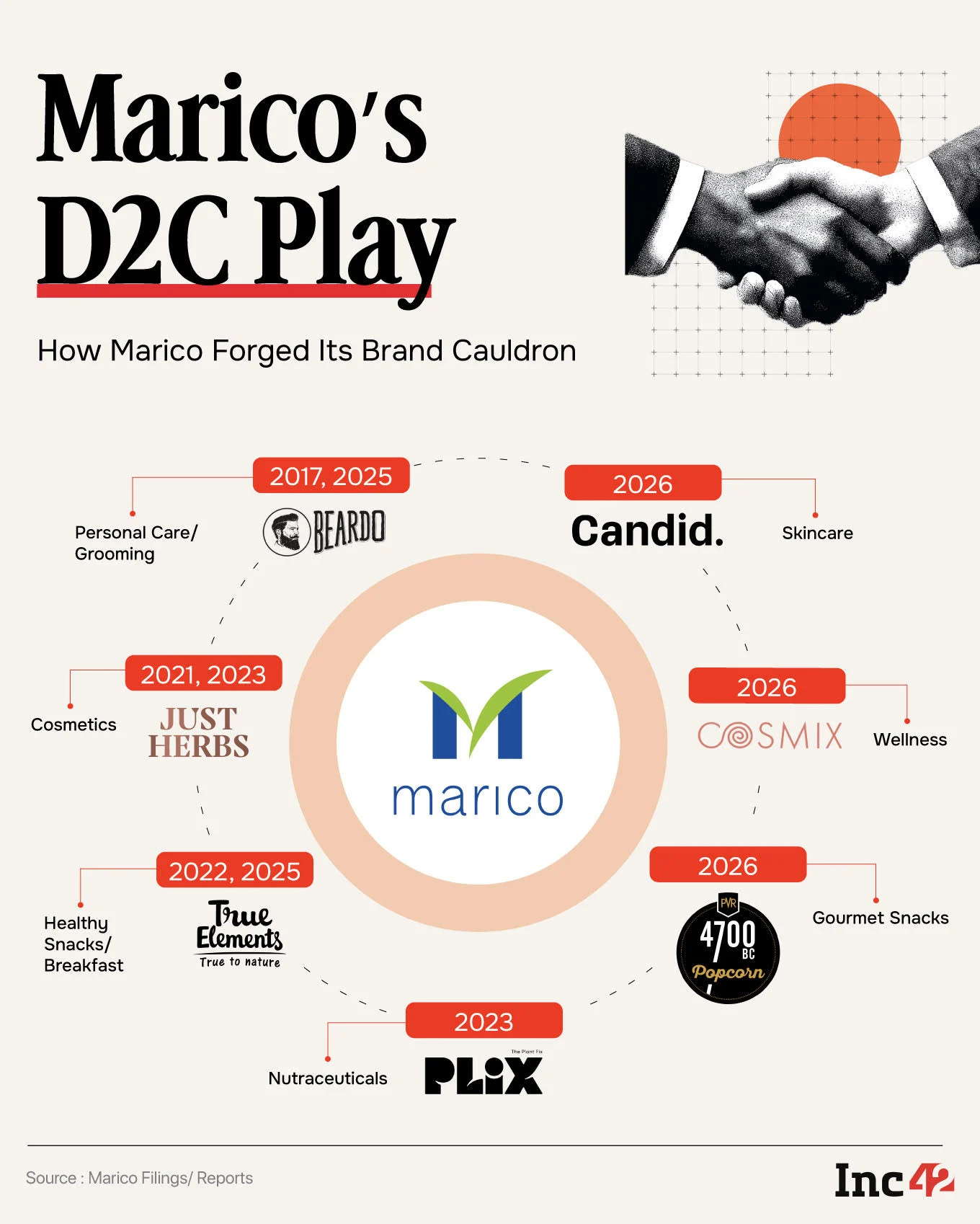
The saga began on January 26, when Marico snapped up a 93.27% stake in gourmet popcorn brand 4700BC’s parent Zea Maize from PVR INOX for INR 226.8 Cr.
Forging its acquisition cauldron further, the FMCG major announced two more deals in February. It picked up a 60% stake in Bengaluru-based plant-based protein startup Cosmix Wellness for INR 226 Cr. It also acquired a 75% stake in Vietnam-based Skinetiq Joint Stock Company for an estimated INR 262-350 Cr.
So what’s driving Marico’s growing appetite for digital-first D2C brands?
“We follow what we call a chessboard theory. We carefully map out the opportunities we can add to our portfolio. We only enter adjacencies where we believe we have a clear right to win, rather than chasing categories simply because they look large or attractive in the short term,” said Marico’s MD and CEO, Saugata Gupta.
At a time when large conglomerates and FMCG majors like Reliance, Tata Group, Hindustan Lever and ITC are eyeing to add digital-first brands to their portfolios, Marico is focussed on balancing founder culture with conglomerate scale.
While this acquisition blitz may look sudden, Marico’s journey into the digital-first world began almost a decade ago in 2017, long before D2C became an industry buzzword.
The roots of Marico’s acquisition-led D2C strategy go back almost a decade. “We started this journey fairly early. The first investment we made was in men’s grooming brand Beardo in 2017,” Gupta said.
That investment was shaped by what Marico saw playing out globally, especially in the US, where large consumer packaged goods (CPG) companies were “slow to adapt to digital brands, which were more nimble and catered to unmet needs.”
Marico chose to take a different route. It built a hybrid model that combines its own scale and distribution strengths with the agility and digital expertise of startup founders.
“We realised early on that we didn’t understand this space as well as the founders did. They know it far better than we do. Building digital businesses organically is extremely difficult — and that’s precisely why we chose this route,” the Marico CEO added.
While the philosophy now dictates how Marico buys, integrates and scales D2C brands, its recent buyouts raise a more pressing question. Are these acquisitions pricey?
“For us, realistic valuation is extremely critical. There is enough opportunity for the founders to grow and achieve strong earn-outs. For instance, 4700 BC has been performing extremely well, and we saw a massive market opportunity in the gourmet snacking space.” Gupta said.
Its exit revenue run rate of approximately INR 140 Cr at the time of acquisition was accompanied by a modest loss on the books.
“With the Marico ecosystem, the path to break-even accelerates meaningfully, and the founders have enough capital to fuel growth. 4700 BC has the potential to become a INR 500 Cr business in 3 years.”
Meanwhile, Cosmix, as per Gupta, adds a premium health and wellness nutrition angle — a category where consumer willingness to pay continues to outpace the broader FMCG market. And the Vietnam move extends Marico’s international digital playbook beyond its existing presence in Southeast Asia.
Across sectors and geographies, acquisitions often follow a familiar script: founders cash out, and the corporate parent brings in its own leadership. This harms brands in many ways, as they either get diluted or gradually lose their identity.
According to Gupta, Marico’s model is built on a different template. “We don’t do 100% buyouts,” Gupta said.
The CEO said that running a high-velocity, digitally native brand requires a very different skill set from managing a legacy CPG portfolio. What Marico follows is a phased acquisition strategy, backed by patient capital deployment.
Marico first acquired a minority stake in the men’s grooming brand in 2017, took time to understand the business, gradually increased its holding to a majority stake, and then scaled the brand to nearly six times its original size over the next five years — all while delivering double-digit profitability.
According to Marico, Zed Lifestyle, the parent company of Beardo, reported a revenue of INR 214.17 Cr in 2025, accounting for nearly 2% of the FMCG giant’s overall revenue. At the time of acquisition, Beardo had a top line of INR 80 Cr.
“The success of Beardo gave us the confidence that we can integrate our operations and resources well with smaller firms,” Gupta says.
This is how Marico approaches every new digital brand deal. Founders are not asked to exit. They are asked to stay and given resources, distribution muscle, and ecosystem access to grow faster than they could have on their own.
“We aim to be the strategic investor of choice for founders who want to build enduring businesses rather than build to sell. We let founders run the operation fairly independently. We learn the business alongside them and scale from there,” the Marico CEO said.
However, the founder-selection process is equally rigorous.
When evaluating a brand and its founding team, Gupta checks a list that comprises repeat rates, revenue quality, contribution margins, hero SKUs, cost structure discipline, and a track record of focused growth.
“Successful D2C brands grow in a focussed way, but above everything is the founder’s mindset. Chemistry with the founder matters. They must have a bold, growth-oriented mindset, while prioritising the path to profitability and quality of revenue,” Gupta said.
It’s this blend of strategic capital and founder-led ambition that underpins Marico’s broader D2C thesis. But how is this strategy translating on the financial front?
In its Q3 FY26 earnings report, Marico officially set its sights on crossing the in INR 1,000 Cr annual revenue run (ARR) mark for its digital business in the current financial year (FY26) itself.
Fuelling these potential numbers is a widening D2C portfolio that now spans Beardo, skincare and cosmetics label Just Herbs, healthy breakfast and snacking brand True Elements, and nutraceuticals player Plix. Cosmix and 4700BC further deepen this growth engine, adding both scale and category diversity.
Gupta, on his part, is convinced that each of these brands can evolve into a INR 500 Cr business in the coming years.
But, what underpins this conviction?
Well, Marico’s handholding and conglomerate muscle turbocharges these digital-first brands by slashing costs and streamlining operations, logistics and raw material sourcing. What further helps is the FMCG major’s clear focus on acquiring brands that align well with the existing portfolio.
“Even though Saffola and True Elements cater to different markets, there are a few synergies between them in areas like procurement and certain operational areas, while each brand continues to operate independently with its own model. These efficiencies improve our profitability metrics,” Gupta stated.
Beyond procurement, the synergies extend to CRM infrastructure, media buying, and the go-to-market architecture.
Simply put, brands share a back-end without sharing a front-end. This allows them to maintain distinct brand identities and consumer positioning while benefiting from cost efficiencies at scale, the CEO elaborated.
This nuanced “house of brands” model sets Marico apart from peers like Hindustan Unilever and ITC, which have also thrown their hats into the D2C ring through a string of acquisitions.
For Marico, the edge isn’t just in the M&A strategy, but in the maturity of an operating model built over nearly nine years.
“We have developed a playbook for being a strategic investor of choice… We will consider ourselves successful if we are the first call for any founder who wants to build a great brand and a lasting legacy,” Gupta said.
To achieve this, the CEO draws a sharp structural distinction between the two business models co-existing within Marico.
“Incumbent large companies are best in the world at having a repeatable model of growth based on scale and efficiency. Innovation is important, but the mantra is fewer, bigger, better,” he said.
In contrast, the D2C arm, as per Gupta, operates on an entirely different logic – high-velocity innovation, starting small, thinking big, and either scaling up or eliminating fast.
The central challenge, he acknowledged, is running both systems simultaneously without the traditional corporate structure ‘infecting’ the agile startup DNA.
The recent explosion of quick commerce has also added a new dimension to how Marico evaluates potential deals.
While Gupta is bullish on the channel’s role in driving innovation and testing new products, he is also cautious about brands whose unit economics only make sense within the quick commerce vacuum.
For Marico, however, the ‘quality of revenue’ remains the ultimate filter.
As the fiscal year draws to a close, Marico, in Gupta’s words, stands as the second-largest FMCG-D2C company in India.
Plix, the most mature digital brand in the stable, has already crossed the ₹500 Cr milestone and is tracking toward breaching the ₹1,000 Cr mark. The rest of the portfolio, comprising Beardo, True Elements, Cosmix, and 4700BC, is being strategically positioned to hit the ₹500 Cr mark individually.
“We are doing a decent job,” Gupta said with a hint of self-deprecation. But, given the buyout pace of the last three weeks, ‘decent’ is a significant understatement.


For media inquiries, feel free to contact our communications and media relations team.
media.connect@marico.com
+91 22 6778 9999
marico@mslgroup.com
+91 22 6778 9999