RISK MANAGEMENT
BEING VIGILANT and action-driven
As the cascading impacts of COVID-19 continue to pose critical threats to the FMCG industry, it is imperative for companies to use risk management as a tool to protect company resources, and maintain operational efficiency, thereby, ensuring business continuity.
Taking a proactive approach, we have re-analysed our exposure to risks across various categories, and strengthened the existing risk management framework, to draw up comprehensive mitigation plans for identified risks.
Risk management framework
Risk management is an integral part of our business strategy. In conducting our business and executing our strategy, we identify the risks, analyse their likelihood, quantify their consequential impact, and prepare our response plan for the same. While managing these risks, we also consider them as opportunities to emerge as a stronger and more agile organisation.
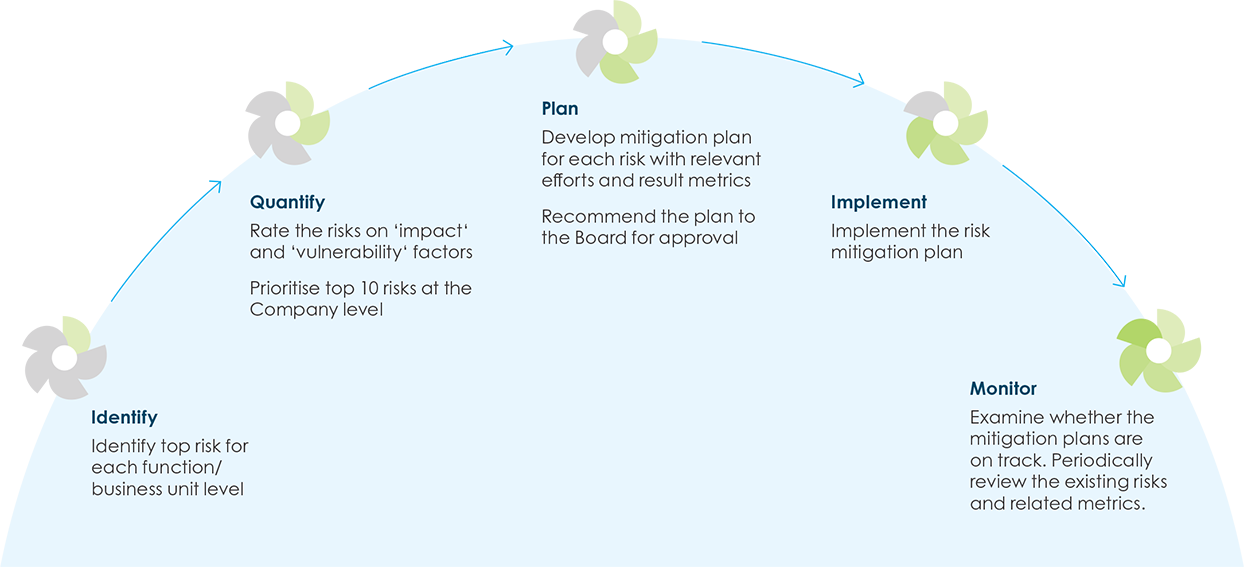
Continuous monitoring of the identified risks is a part of our practice, where we track the effectiveness of our efforts and update the Risk Management Committee on the progress. Risk related issues, if any, are discussed at review meetings. The Committee looks after strategic as well as operational risks.
Risk Management Committee governance structure
Our risk management process scans through all significant business processes to identify risks that can be classified under following categories:
Risk Management Committee (RMC)
and CEO, and the Chief
Financial Officer
annually by the RMC
strategic and operational
level
Key risk categories and mitigation plans
Our risk management process scans through all significant business processes to identify risks that can be classified under following categories:

Strategic risks

Financial risks

Operational risks

Compliance and Governance risks

ESG risks
Strategic Risks
Risk Type and Description
Changing
consumer
preferences
Consumer tastes, preferences and behaviours have been evolving over the years. This trend has only accelerated after unexpected events post the outbreak of the pandemic. In addition, with increasing social media penetration, brand awareness levels and the speed of shifts in consumer preferences has dramatically risen. It is, therefore, an imperative that our portfolio and brand communication also evolves in line with consumer demand so that we continue to remain relevant and competitive in our categories.
Mitigation Strategies/Efforts
- Investment in consumer in-sighting to adapt to changing consumer preferences
- Actively monitor social media trends to spot early consumer trends; quickly respond to these trends with innovative offerings that lead with quality, safety and nutritional quotient
- Shape brand communication to effectively reach the consumer and convey its proposition and purpose
- Frequent consumer awareness campaigns and outreach initiatives to demonstrate the nutritional value of products and the use of safe ingredients to enhance product responsibility
Risk Type and Description
Increasing
Competitive
intensity
With the increasing number of competing brands across offline and online marketplaces, counter campaigning and aggressive pricing by competitors, maintaining brand relevance, market shares and pricing power is critical to sustained growth.
Mitigation Strategies/Efforts
- Diversification in product offerings and ensuring availability in relevant channels thereby leading to wider presence and reach
- Protect consumer franchise during periods of short-term volatility or headwinds
- Invest in brand building through responsible marketing campaigns
- Building agile marketing response mechanisms to counter competitive moves
Risk Type and Description
Underperformance
of new product
launches
Given that the success rate for new product launches in the FMCG sector is typically low, new products may not gain traction among consumers or may fail to scale up as planned. This risk is pronounced in cases where industry leaders invest in creating new categories.
Mitigation Strategies/Efforts
- Invest in a new product development process with a funnel approach to ensure continuous flow of new ideas coupled with rigorous governance around scalable ideas
- Prototyping approach to new product introductions for accelerated learning and adjustment
- Identify and invest in big-ticket new ideas in the chosen categories for driving growth
- Resilient presence in marketplace with adequate investments in brand building
Risk Type and Description
Underachievement
of acquisition
deliverables
Acquisitions may impose a financial burden on the parent entity, if the acquired business significantly underperforms visa-vis expectations. Integration of operations and cultural harmonisation may also take time, thereby deferring benefits of synergies.
Mitigation Strategies/Efforts
- A well-defined playbook for selection of targets, due diligence, value finalisation and integration
- Well-defined performance tracking systems for monitoring progress periodically
- Cross-application of governance practices of the parent organisation soon after take over to ensure controls
Financial Risks
Risk Type and Description
Volatility in
interest rates
Though the FMCG sector is not capital intensive, fund requirements arise on account of inventory position building, capital expenditure undertaken or funding inorganic growth. Changes in the interest regime and in the terms of borrowing could impact the financial performance of the Company. Further, this risk may also impact income on Company’s investment and lead to mark-to-market losses on its investment portfolio.
Mitigation Strategies/Efforts
- Well-defined framework for capital gearing
- Maintain a liquidity chest for immediate working capital requirements
- In case of foreign currency borrowings, implement hedging as per policy
- Manage interest rate risk to investments by implementing a Board-approved investment policy, which focuses on safety and liquidity, thereby mitigating short-term interest risks
Risk Type and Description
Foreign currency
exposure
Marico has significant local presence in Bangladesh, South East Asia, Middle East, Egypt and South Africa. The Company is thus exposed to a wide variety of currencies. Fluctuations in these currencies could impact the Company’s financial performance. The risk of currency depreciation is accentuated during periods of high inflation in these economies.
Mitigation Strategies/Efforts
While the ‘translation risk’ will continue to be unhedged, Marico has a well-defined hedging framework for managing any foreign exchange risk in India and Bangladesh. The Board-approved policy in this regard is periodically reviewed for its effectiveness.
Operational Risks
Risk Type and Description
Commodity risk
Unexpected changes in commodity prices and supply could impact business margins and ability to service demand. The past few years have witnessed wide fluctuations in input prices. As a result, the overall uncertainty in the environment continues to be high.
Mitigation Strategies/Efforts
- A comprehensive process manual drives commodity procurement for each of the categories, which governs norms related to price discovery, inventory policy, supplier management, governance mechanism
- The Company policy defines purchase of commodity in line with business requirement in accordance with inventory policy and does not encourage speculative buying or trading of said commodity either in physical form or on the exchanges
- The Company has developed and deployed various programmes in order to ensure sustainable availability of agriculture commodities to support future business requirements. Few of the programmes are:
- Sponsoring research in agriculture breeding technology;
- Developing strategic souring alternatives from other geographies; /li>
- Strategic presence in the extended backward value chain
The Company has well-defined norms for building strategic inventory positions as a hedge against price volatility.
Risk Type and Description
Geo-political instability in operating geographies
Unrest and political instability in countries of operation could significantly impact business results.
Mitigation Strategies/Efforts
- A comprehensive insurance programme to hedge all insurable risks
- At a macro level, our country selection template lay emphasis on geopolitical stability and robust growth prospects
Risk Type and Description
Macro-economic factors
Factors such as low GDP growth and high food inflation could result in down trading from branded to non-branded or premium to mass market products
Mitigation Strategies/Efforts
- Focus on value-added products available to masses at affordable prices by driving aggressive cost management
- Focus on franchise growth over short-term profitability during macro-economic headwinds
- Thrust on portfolio diversification as one of the pivots of future growth
Risk Type and Description
Cyber and data security
Disruption in business operation due to nonavailability of critical Information Systems through cyber-attack and loss of sensitive information due to unauthorised access.
- Identification of business critical IT systems and having a disaster recovery plan in place. The plans are tested periodically for scope of enhancements
- Implementation of IT security practices in line with ISO 27001 standard
- Implementation of latest cyber security technologies with preventive, detective and reactive controls
- We perform periodic internal assessments for the controls implemented for the continuity of the operations
- Mock Runs are conducted to ensure that all controls are performing as expected and all relevant stakeholders are aligned on their roles in the event of a cyber-crisis
Compliance and Governance risks
Risk Type and Description
Non-compliance with regulatory requirements
Inadequate compliance systems and processes can pose reputation risk for the Company. This could expose the Company to legal consequences; result in financial losses and penalties.
Mitigation Strategies/Efforts
- Invest in IT-enabled compliance systems and processes
- Ensure all functions and units are aware of the laws and regulations to comply with
- Ensure adequate monitoring mechanism towards compliance
- Communicate periodically to reiterate the importance of compliance
Risk Type and Description
Violation of ethics and business integrity
Failure to act with integrity or behave in a manner inconsistent with Marico’s purpose statement and values defined can damage the corporate reputation and affect business results.
Mitigation Strategies/Efforts
- Code of Conduct (CoC) and Marico Code of Business Ethics (MCoBE) outlines the Company commitment to ethics and integrity
- Robust vigil mechanism, which enables all stakeholders to report, concerns about unethical behaviour, fraud or violation of code
- Detailed personal orientation and mandatory certification on CoC for all employees, suppliers and contractual workers
- Effective oversight by the Board of Directors
ESG Risks
Risk Area(s)
Climate change
impacts
Material Risk(s)
Carbon
emissions
Mitigation Strategies
Reduction in direct and indirect emissions footprint through:
- Investment in low-carbon technologies and equipment
- Increase in share of renewable and clean energy
- Carbon sequestration through afforestation
Risks turned into Opportunities
- Minimisation of environmental footprint from operations; enhanced fuel, energy, and cost savings
Reduction in
agricultural
productivity
- Mapping of physical climate
risks across agri-value chain - Deployment of sustainable coconut cultivation measures to improve climate resilience
- Establishing traceability of agrobased raw materials directly from the source of origin
- Boosting productivity and livelihood generation for farmers by deploying sustainable agricultural techniques
Risk Area(s)
Pollution
from waste
generation
Material Risk(s)
Increased cost of operations due to plastic waste material handling
Mitigation Strategies
- Dematerialisation, use of recycled as well as recyclable plastic materials in packaging
- 100% compliance to Extended Producer Responsibility (EPR) framework to ensure collection, proper recycling/coprocessing, and environmentally safe disposal of pre- and postconsumer plastic waste
Risks turned into Opportunities
- Creation of sustainable packaging portfolio based on circularity principles
- Minimisation of products’ emissions footprint, thus reducing the overall Scope 3 emission intensity
- Active participation in promoting circular economy principles within sectoral and market dynamics
Risk Area(s)
Natural resource
depletion
Material Risk(s)
Water
shortages
Mitigation Strategies
- Source water vulnerability assessment for all operations (using scientific tools and methods) to identify water stress quotients near Marico’s manufacturing footprint. Replenishment of equivalent volumes of water as consumed in operations, through various capacity creation measures that benefit local community and agriculture
- Installation of water efficient measures, rainwater storage units and technological upgrades across commercial and operational premises
- Integrating zero liquid discharge principles
Risks turned into Opportunities
- Rejuvenation of water balance in the ecosystem through replenishment of reserves in areas of water stress
- Reduced dependence on freshwater sources by switching to stored rainwater within facilities to meet process-related requirements, and recycling effluents for industrial and domestic consumption
Fuel shortages
leading
to energy
unavailability
- Conservation of energy by increasing investments in energy-efficient systems
- Increase in share of renewable and clean energy
- 100% phase-out of fossil fuel consumption
Minimisation of overall GHG footprint by transitioning to low carbon energy sources
Risk Area(s)
Product
footprint
Material Risk(s)
Product
safety
Mitigation Strategies
Conducting Product Sustainability Assessments (PSI) for top product SKUs (by revenue) to measure product quality, ingredient safety, and product environmental footprint across lifecycle, and certify products on internal standards
Risks turned into Opportunities
- Reduction in environmental and social footprint of products
- Establishment of traceability
- Ensuring 100% compliance with world-class quality and safety norms
- Accelerating consumercentric product innovation
Risk Area(s)
Employment
concern
Material Risk(s)
Talent
acquisition
and retention
Mitigation Strategies
- Promoting culture of diversity, inclusion, openness, transparency, and meritocracy, coupled with growth orientation, to help attract top talent and retain
- Investing in ‘hiring right’, ‘talent development and engagement’ best practices
Risks turned into Opportunities
- Attracting and retaining diverse talent, especially the workforce of tomorrow
- Redefining the future of work
- Building a socially inclusive and responsible culture that leads with ethics, ownership, and trust
Employee
health safety
and well being
- Focus on reducing risk exposure and enhancement of mitigation practices across facilities though training, monitoring, and implementation of safe practices
- Promoting SHE and social accountability related policies to demonstrate safe and socially inclusive behaviour at workplace
- Driving employee engagement and wellbeing programmes for better mental health and stressfree life
- Risk- free operations and improved productivity
- Building a safe and sustainable working environment to boost employee motivation
Risk Area(s)
Social
responsibility
Material Risk(s)
Supply chain
disruptions
Mitigation Strategies
- Promoting local procurement
- Implementation of responsible sourcing framework ‘Samyut’ for critical suppliers - raw material, packaging material suppliers, depots and warehouses, third party manufacturing units
- Advocating business ethics and human rights principles through trainings and business communications for all suppliers to help them imbibe human rights principles in their operations
Risks turned into Opportunities
- Adoption of responsible business practices across value chain
- Promotion of local, indigenous produce that has a significantly lower environmental footprint
Social license
to operate
- Constant engagement with
local community stakeholders to understand their needs - Continue to implement social outreach programmes and initiatives to deliver socio-economic, environmental, educational and health-related benefits
Inducing stakeholder capitalism amongst communities that matter